
 EN
EN  简体中文
简体中文 English
 Français
 Español
 عربي
عربي Русский
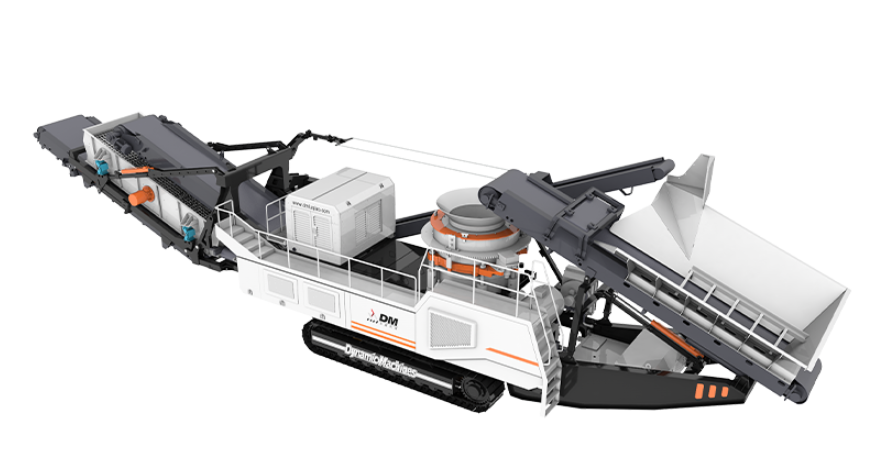
Machinery Weight 55-72t
Max Feeding size(mm) ≤700mm
Hopper Volume(m³) /



 REQUEST A QUOTE
A cone crusher factory is rarely a quiet environment. There is constant movement, short pauses, and then movement again. Large steel parts travel between different working areas, sometimes slowly, sometimes with clear urgency. Nothing feels random, but it also doesn't feel overly rigid.
What becomes a finished crusher is not formed in one step. It is built gradually through a chain of practical actions that often look simple on the surface.
Materials do not go straight into production. They usually sit for a short period in receiving areas before anything else happens. The first task is not shaping or cutting, but sorting.
Different materials arrive in different conditions. Some are closer to usable form, others need more preparation. At this point, everything is just "raw input."
Typical handling includes:
It feels like preparation work, but it sets the pace for everything that follows.
Once materials enter processing, the workflow becomes more steady. Large pieces are shaped gradually into usable components. This is not a single transformation. It happens in stages.
Some parts reach form earlier, while others stay in rough condition for longer. There is often a back-and-forth between shaping and adjustment.
What usually appears at this stage:
Nothing is fully complete yet. It is more like progress than finish.
Assembly areas tend to feel the most active. Parts begin to come together, but rarely fit perfectly on the first attempt.
A frame may look stable at first, but once internal components are added, small misalignments often appear. That is normal in this kind of production.
Work usually moves like this:
It is not a one-direction process. It moves forward and slightly backward at the same time.
Surface treatment is not just about appearance. In a cone crusher, surfaces are in constant contact during operation, so even small imperfections can matter later.
Inside the factory, this step is handled carefully but without unnecessary complexity.
It usually includes:
After this stage, components feel more consistent when handled, even before final assembly.
Inside a cone crusher, internal systems need to work in coordination rather than isolation. Installation happens step by step, not as a single action.
Each component is positioned, checked, and then adjusted if needed. It is common for small changes to happen during fitting.
The process often looks like:
Even small deviations are taken seriously because they affect how the system behaves later.
Inspection is not saved for the end. It appears at different points in the process.
Instead of one large check, there are many smaller ones. This helps catch differences early, before they build up.
Common inspection moments include:
Most of these checks are quick and practical. They focus on whether things "fit right" rather than detailed measurement.
Final assembly is where separate systems become one complete machine. Parts that were previously tested on their own are now connected into a full structure.
At this stage, the focus shifts from individual components to overall behavior.
Work usually includes:
The machine begins to look complete, but final confirmation still comes later.
Before leaving the factory, the machine goes through controlled testing. The goal is not to push limits, but to observe whether everything works together smoothly.
Testing is usually calm and structured. It focuses on how the system behaves under normal operation conditions.
What is observed:
If something feels off, adjustments are made before moving forward.
Once testing is complete, attention shifts to protection and transport readiness. Cone crushers are heavy and require careful handling.
Preparation is practical rather than complex.
Typical steps include:
At this point, factory production is finished, but coordination continues outside the factory environment.
A cone crusher factory depends on coordination between many small stages. If one part slows down, others adjust accordingly.
The system is not linear. It is more like a continuous flow with small internal corrections.
Stability usually comes from:
This keeps production moving without large interruptions.
Cone crushers are used in systems where stable output is important. If each unit behaves differently, the downstream process becomes harder to manage.
Inside the factory, consistency is built through repetition and comparison, not perfection.
It depends on:
The goal is not identical output, but predictable behavior.
No two production runs feel exactly the same. Materials behave slightly differently, and workload shifts over time.
Instead of forcing strict uniformity, factories manage variation within acceptable limits.
This is handled through:
The system stays stable, even when conditions change slightly.
A China Cone Crusher is considered complete when all systems behave consistently together, not just when parts are assembled.
Completion usually means:
At this point, the equipment is ready to leave the factory and enter real working conditions.
Machinery Weight 53-62t
Max Feeding size(mm) ≤600mm
Hopper Volume(m³) 80-360t/h
Machinery Weight 55-57t
Max Feeding size(mm) ≤215mm
Hopper Volume(m³) /
Machinery Weight 33-35t
Max Feeding size(mm) 150-400t/h
Hopper Volume(m³) 2.5
Machinery Weight 33t
Max Feeding size(mm) 150-400t/h
Hopper Volume(m³) 7m³
Machinery Weight 54-63t
Max Feeding size(mm) ≤600mm
Hopper Volume(m³) /
Machinery Weight 9.5-75t
Max Feeding size(mm) ≤1000mm
Hopper Volume(m³) 61-1204t/h
Just let we know what you want, and we will get in touch with you as soon as possible!

A high-tech enterprise integrating R&D, production, sales and service of crawler and stationary crushing and screening.
Scan the Mobile QR code
 Tel: +86 21-6891 1957
 Fax: +86 21-3756 6069
 E-mail: sales@dmcrushers.com
 Add: No. 1188,Fengliang Road, Fengcheng Town, Fengxian District, Shanghai, China