
 EN
EN  简体中文
简体中文 English
 Français
 Español
 عربي
عربي Русский
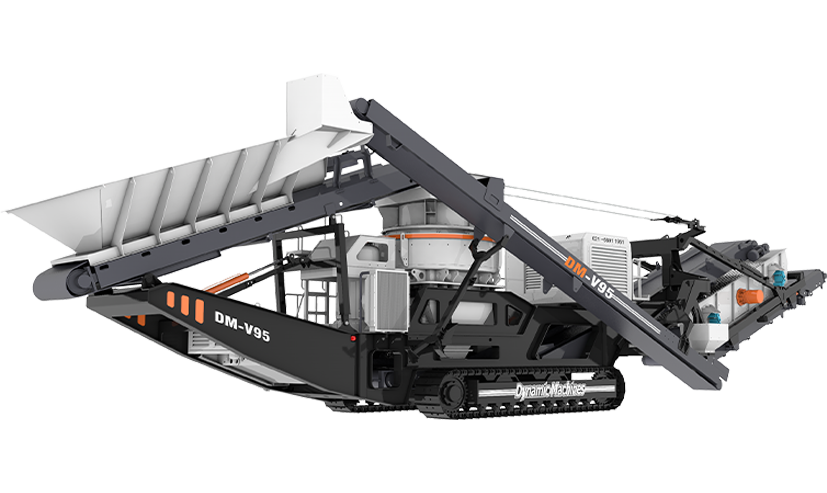
Machinery Weight 55-72t
Max Feeding size(mm) ≤700mm
Hopper Volume(m³) /



 REQUEST A QUOTE
The discharge particle size of a crushing system is strongly influenced by equipment selection and internal structure. A professional Stone Crushing Machine Factory typically optimizes machine configuration to achieve stable and adjustable output gradation.
1. Crusher Type Selection
Different crushers operate under different crushing principles. Jaw crushers mainly perform compression crushing and are suitable for primary stages, usually producing coarser material. Cone crushers and impact crushers are better for secondary or tertiary stages, delivering finer and more uniform aggregates.
2. Crushing Chamber Geometry
The shape and depth of the crushing chamber determine how materials are compressed or impacted. A well-designed chamber improves material flow and reduces uneven particle size distribution. Poor structural design may cause excessive coarse particles or over-crushing.
3. Discharge Opening Adjustment
The size of the discharge opening directly controls the output size. A smaller opening causes finer products, while a larger opening increases output size. Precise adjustment systems provided by a Stone Crushing Machine Factory help maintain consistent particle control.
Material characteristics significantly affect crushing efficiency and final gradation. Even advanced equipment cannot compensate for unsuitable raw materials or unstable feeding.
1. Material Hardness and Strength
Hard stones such as basalt or granite require a stronger crushing force. If the equipment capacity is insufficient, the output may remain relatively coarse. Softer materials like limestone are easier to crush into finer particles.
2. Moisture Content
High moisture content may cause materials to stick inside the chamber, reducing crushing efficiency and blocking the discharge port. This results in inconsistent particle sizes and unstable output.
3. Feed Size and Uniformity
Excessively large or uneven feed materials create fluctuating pressure inside the chamber. Pre-screening and controlled feeding ensure better size control and prevent oversized discharge.
Proper operational adjustment plays a key role in achieving the desired discharge particle size.
1. Closed Side Setting (CSS)
The CSS defines the gap between crushing surfaces. Reducing the gap produces finer material, while increasing it generates coarser output. Accurate control of this parameter is essential for gradation management.
2. Rotational Speed
Higher rotational speed increases the frequency of crushing actions, which may result in finer output. However, excessive speed can cause equipment wear and unstable performance.
3. Feeding Rate Stability
Overfeeding reduces effective crushing time and may cause oversized particles. Underfeeding decreases efficiency and affects output uniformity. Stable and continuous feeding ensures consistent gradation.
Long-term operation inevitably causes wear, which directly affects discharge particle size.
1. Liner and Hammer Wear
As liners or hammers wear down, the crushing gap increases, producing coarser materials. Regular inspection and replacement are essential to maintain a stable output size.
2. Mechanical Alignment
Misalignment of shafts or bearings can cause uneven crushing force, resulting in inconsistent particle distribution.
3. Lubrication System Efficiency
Proper lubrication reduces friction and heat generation. Overheating or insufficient lubrication may affect equipment precision and indirectly impact particle size control.
The final output size is not determined by the crusher alone but by the overall production system.
1. Vibrating Screen Efficiency
Efficient screening separates qualified materials and returns oversized particles for re-crushing, ensuring more accurate gradation.
2. Closed-Circuit Crushing System
Closed-circuit systems improve particle size control by continuously recirculating oversized materials.
3. Multi-Stage Crushing Design
Combining primary, secondary, and tertiary crushing stages allows for gradual size reduction and better final particle uniformity.
The output particle size of a crushing system is influenced by equipment design, material characteristics, operational parameters, wear conditions, and overall system configuration. Effective size control requires proper equipment selection, accurate parameter adjustment, and consistent maintenance. By understanding these factors, operators can achieve stable, uniform aggregates that meet different construction and industrial standards.
Machinery Weight 53-62t
Max Feeding size(mm) ≤600mm
Hopper Volume(m³) 80-360t/h
Machinery Weight 55-57t
Max Feeding size(mm) ≤215mm
Hopper Volume(m³) /
Machinery Weight 33-35t
Max Feeding size(mm) 150-400t/h
Hopper Volume(m³) 2.5
Machinery Weight 33t
Max Feeding size(mm) 150-400t/h
Hopper Volume(m³) 7m³
Machinery Weight 54-63t
Max Feeding size(mm) ≤600mm
Hopper Volume(m³) /
Machinery Weight 9.5-75t
Max Feeding size(mm) ≤1000mm
Hopper Volume(m³) 61-1204t/h
Just let we know what you want, and we will get in touch with you as soon as possible!

A high-tech enterprise integrating R&D, production, sales and service of crawler and stationary crushing and screening.
Scan the Mobile QR code
 Tel: +86 21-6891 1957
 Fax: +86 21-3756 6069
 E-mail: sales@dmcrushers.com
 Add: No. 1188,Fengliang Road, Fengcheng Town, Fengxian District, Shanghai, China