
 EN
EN  简体中文
简体中文 English
 Français
 Español
 عربي
عربي Русский
Machinery Weight 55-72t
Max Feeding size(mm) ≤700mm
Hopper Volume(m³) /



 REQUEST A QUOTE
A China Jaw Crusher machine is built for one very direct purpose. It takes large, hard material and breaks it down into smaller pieces through repeated squeezing action. At first glance, it looks like a single heavy steel structure. But once it is running, the inside behaves more like a coordinated mechanical rhythm.
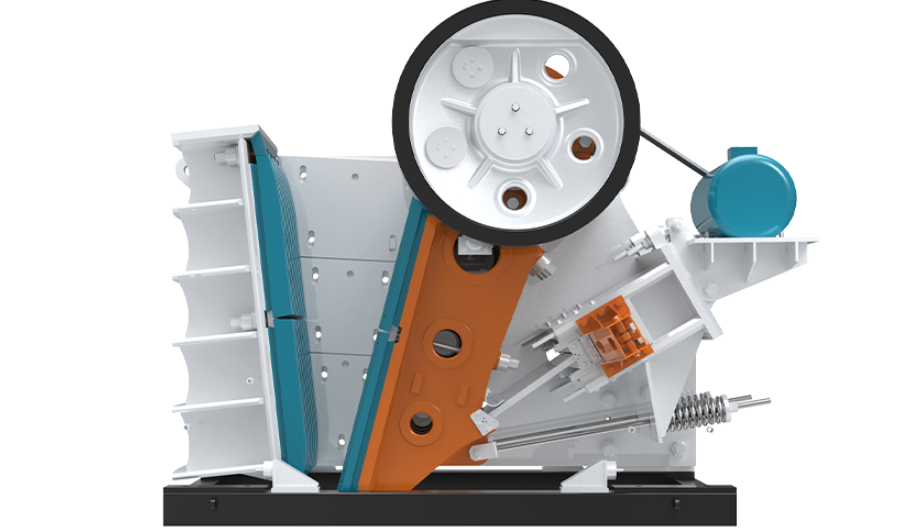
Every movement inside the machine comes from a chain of connected parts. Nothing works alone. Force is created, transferred, absorbed, and released step by step.
Before going into details, it helps to see the machine as a set of connected units rather than isolated components.
| Part | What it does | How it behaves in operation |
|---|---|---|
| Frame | Holds everything in place | Remains still while absorbing vibration |
| Jaw plates | Break material | Constant contact and compression |
| Pitman | Transfers motion | Moves back and forth under load |
| Eccentric shaft | Creates motion | Off-center rotation drives movement |
| Toggle plate | Guides force | Acts like a buffer under pressure |
| Flywheel | Smooths energy | Keeps rotation steady |
| Bearings | Reduce friction | Support moving shafts |
| Lubrication system | Reduce wear | Keeps motion smooth and cool |
| Discharge opening | Material exit | Controls final size |
This layout already shows something important. The machine is not "one crushing unit" , it is a chain of movement.
The frame is often treated as background structure, but in reality it is doing a lot more than just "holding parts".
When the machine starts running, vibration spreads through the whole body. The frame absorbs part of that energy and keeps everything from shifting out of position. If the frame moves even slightly, the alignment of the crushing chamber changes.
That matters because the crushing space is defined by fixed geometry. Once that geometry changes, the way material breaks also changes.
In daily operation, the frame quietly takes the stress without showing visible movement. It is the part that keeps everything grounded.
Jaw plates are the only parts that directly touch the material. One side stays fixed. The other side moves inward and outward.
Material enters from the top and gets trapped between them. At first, nothing seems to happen. Then pressure starts building. The particles do not break all at once. They crack gradually.
There is a repeating pattern here:
It is not a single crushing moment. It is repeated squeezing until the material cannot hold its structure anymore.
Over time, the surface of the plates becomes smoother due to wear. That also slowly changes how the material breaks.
Inside the machine, motion does not come from a simple rotation. It comes from an offset movement.
The eccentric shaft rotates, but not in a perfect circle around its center. That slight offset is enough to push the pitman up and down in a controlled rhythm.
The pitman then pushes the movable jaw.
So the chain looks like this in reality:
It feels mechanical, but the motion is actually very repetitive and steady. That repetition is what makes crushing continuous instead of random.
The toggle plate is small compared to the main structure, but it plays a very sensitive role.
When pressure inside the crushing chamber rises, force needs somewhere to go. The toggle plate takes part of that load. It bends slightly instead of transferring everything directly to the frame.
This controlled flexibility prevents sudden stress spikes.
It also helps guide the movement back into position after each compression cycle. Without it, the motion would feel harsh and unstable.
It is not just a connector. It is also a pressure relief point.
A jaw crusher does not run with perfectly smooth force input. The load changes every time material is crushed. That creates uneven resistance.
Flywheels help balance that.
They store energy when resistance is low and release it when resistance increases. This reduces sudden changes in speed.
The transmission system carries power from the external source into the internal shaft system. It keeps motion connected so that every part moves in sync.
Without this balance, the machine would feel like it is pulsing instead of running smoothly.
Bearings are placed wherever something rotates or swings. Their job is simple: reduce direct metal contact.
But inside a jaw crusher, the pressure is not simple. It is constant and heavy. So bearings are not just about smooth movement. They are about survival of motion under load.
Lubrication supports them by creating a thin protective layer. It reduces heat and slows down surface wear.
A simple way to understand it is this:
If either one weakens, the system starts becoming rough and unstable.
At the bottom of the machine, material leaves through the discharge opening. This is not just an exit point. It is also a control point for output size.
If the gap is smaller, material stays longer inside the crushing chamber. That means more compression cycles happen before it exits.
If the gap is wider, material leaves sooner with less reduction.
So the opening indirectly controls how long material stays in the system.
There is also a simple flow logic:
If this area gets blocked, the whole system slows down quickly.
What makes a jaw crusher interesting is not any single part. It is how everything reacts together in a continuous loop.
Material enters. Pressure builds. Motion repeats. Friction is controlled. Energy is balanced. Then material leaves.
No step stands alone. Each action depends on the one before it.
Even small changes in alignment or wear can slowly shift the behavior of the entire system. That is why operation always feels like watching a steady mechanical rhythm rather than separate actions.
In real working conditions, it is less about individual components and more about how smoothly they continue interacting under pressure, cycle after cycle.
Machinery Weight 53-62t
Max Feeding size(mm) ≤600mm
Hopper Volume(m³) 80-360t/h
Machinery Weight 55-57t
Max Feeding size(mm) ≤215mm
Hopper Volume(m³) /
Machinery Weight 33-35t
Max Feeding size(mm) 150-400t/h
Hopper Volume(m³) 2.5
Machinery Weight 33t
Max Feeding size(mm) 150-400t/h
Hopper Volume(m³) 7m³
Machinery Weight 54-63t
Max Feeding size(mm) ≤600mm
Hopper Volume(m³) /
Machinery Weight 9.5-75t
Max Feeding size(mm) ≤1000mm
Hopper Volume(m³) 61-1204t/h
Just let we know what you want, and we will get in touch with you as soon as possible!

A high-tech enterprise integrating R&D, production, sales and service of crawler and stationary crushing and screening.
Scan the Mobile QR code
 Tel: +86 21-6891 1957
 Fax: +86 21-3756 6069
 E-mail: sales@dmcrushers.com
 Add: No. 1188,Fengliang Road, Fengcheng Town, Fengxian District, Shanghai, China